Web App · 2026
RWCBM
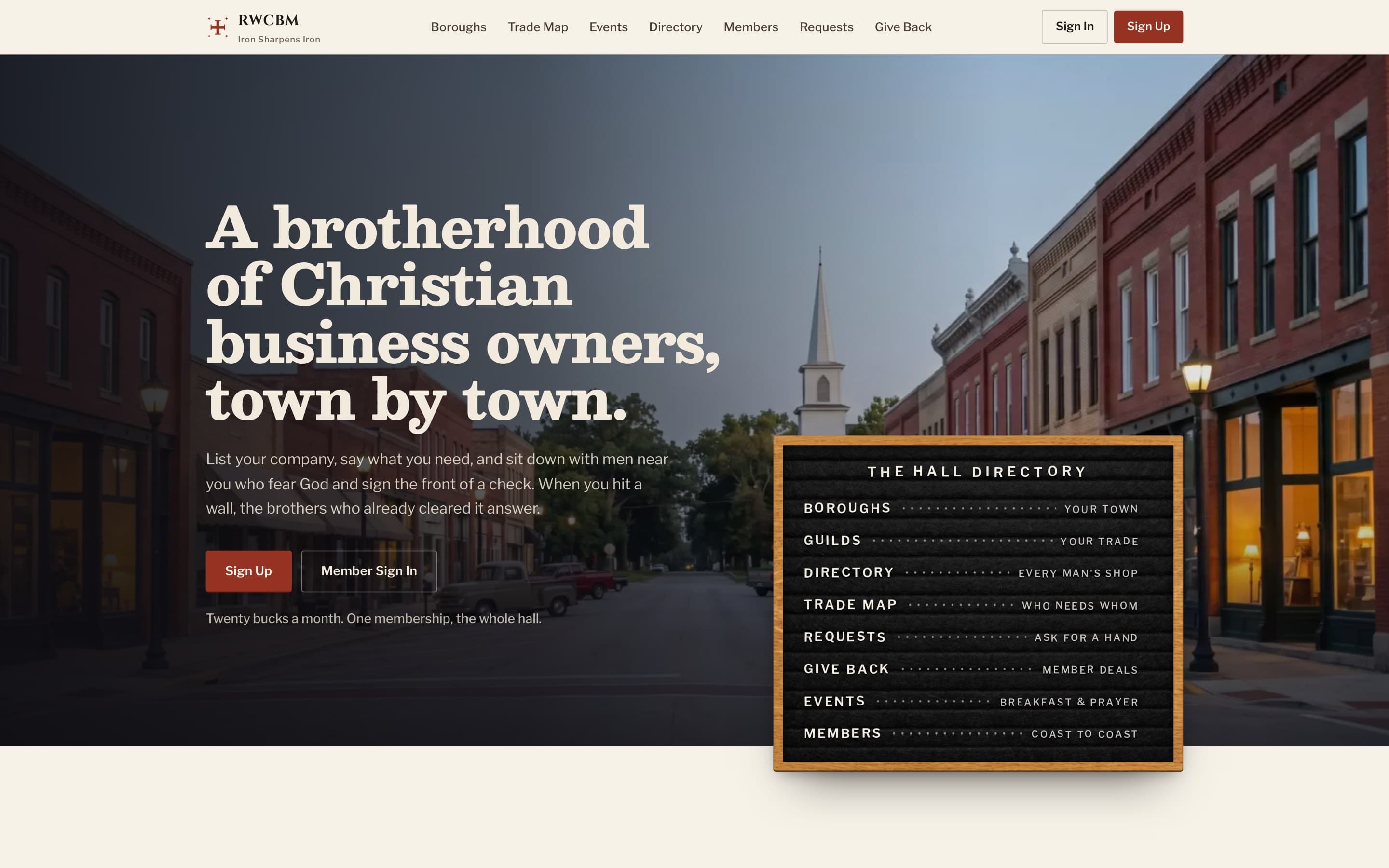
A private hall for Christian business owners, town by town
A member lists his company, joins the borough nearest him or a guild for his trade, asks the brothers for a hand when he hits a wall, offers them a members-only deal, and logs the work they do together so both boroughs get the credit. Twenty dollars a month, on the web and in an app where the messages are end-to-end encrypted.
- Messages encrypted on the phone with Signal's library
- End to endMessages encrypted on the phone with Signal's library
- The Trade Map redrawn from every listing
- WeeklyThe Trade Map redrawn from every listing
- AI-friendly checks passed
- 9 of 9AI-friendly checks passed
The problem
A members' directory is easy. One that men will put their real numbers into, that works town by town rather than as one long national list, and that can show whether anybody actually did business is not. The hall needed local chapters with officers of their own, a way to ask for help without publishing a cell number, somewhere to talk that even the people running it cannot read, and a count of work done that one man's word alone cannot inflate.
What got built
Next.js 14 on Clerk, Neon Postgres and Stripe. The Stripe webhook mirrors each membership into the sign-in session, so the edge turns a lapsed member away without a database read. Behind the door are 94 pages over 208 API routes and 16 scheduled jobs, with 39 kinds of notification, each with its own in-app, email and push setting. Privacy is per field: business details are visible to members, a personal phone or email only if he shares it, and a contact form sends mail without exposing either address. In August 2026 messaging moved into the Expo app and onto Signal's own library, wrapped in a native module written in Swift and Kotlin: the server is a directory of public keys and a relay for ciphertext, and private keys never leave the phone's Keychain or Keystore. A listing can be drafted from the member's own website, and nothing is published until he approves it. The tests are 22 plain Node suites, nine of them running real SQL on PGlite. On 2 October 2026 the public site was rebuilt as a heartland Main Street, with a page for each part of the hall and a letterboard on every one.
Details worth naming
- Open sign-up at $20 a month through Stripe, with membership carried in the sign-in session, so a lapsed member is stopped at the edge on the web and by a single 402 in the app.
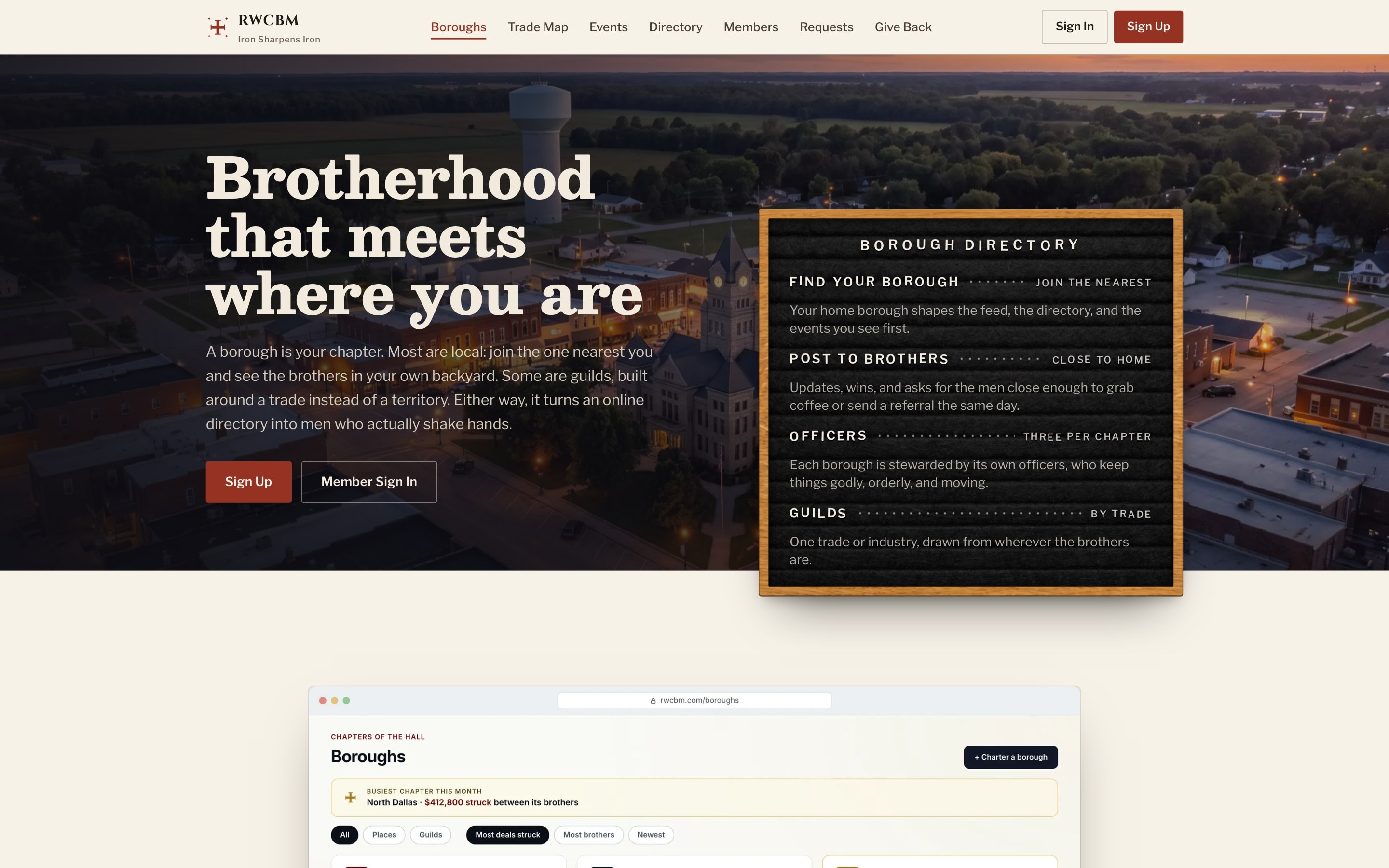
- Boroughs and guilds: a chapter claimed by state, county or ZIP, or chartered around a trade, each kept by three officers with its own wall, calendar, rooms and roster.
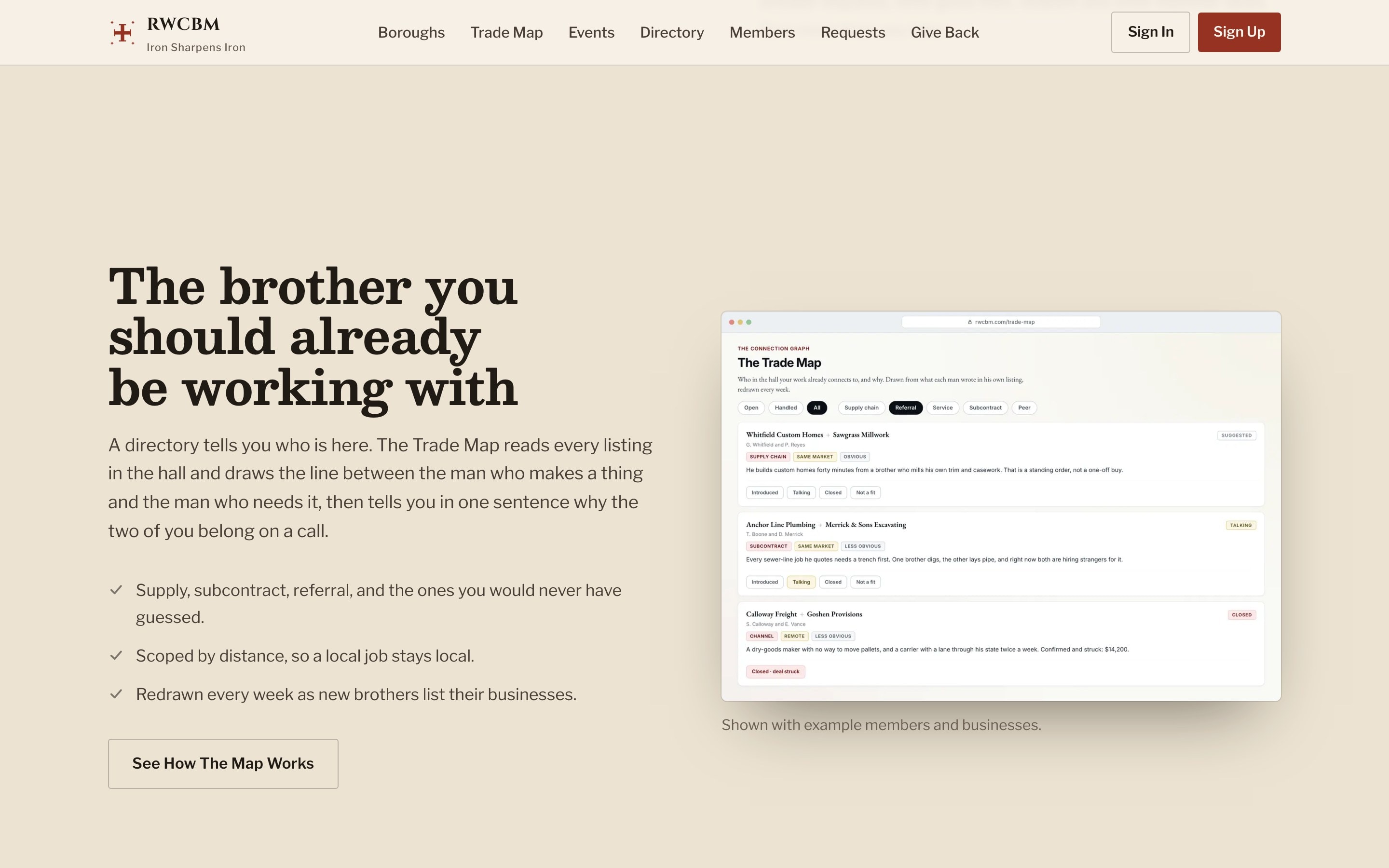
- The Trade Map reads every listing in the hall and pairs the man who makes a thing with the man who needs it: eight kinds of connection, scoped by distance, redrawn every week, and labelled as a reading of two listings rather than an agreement between two men.
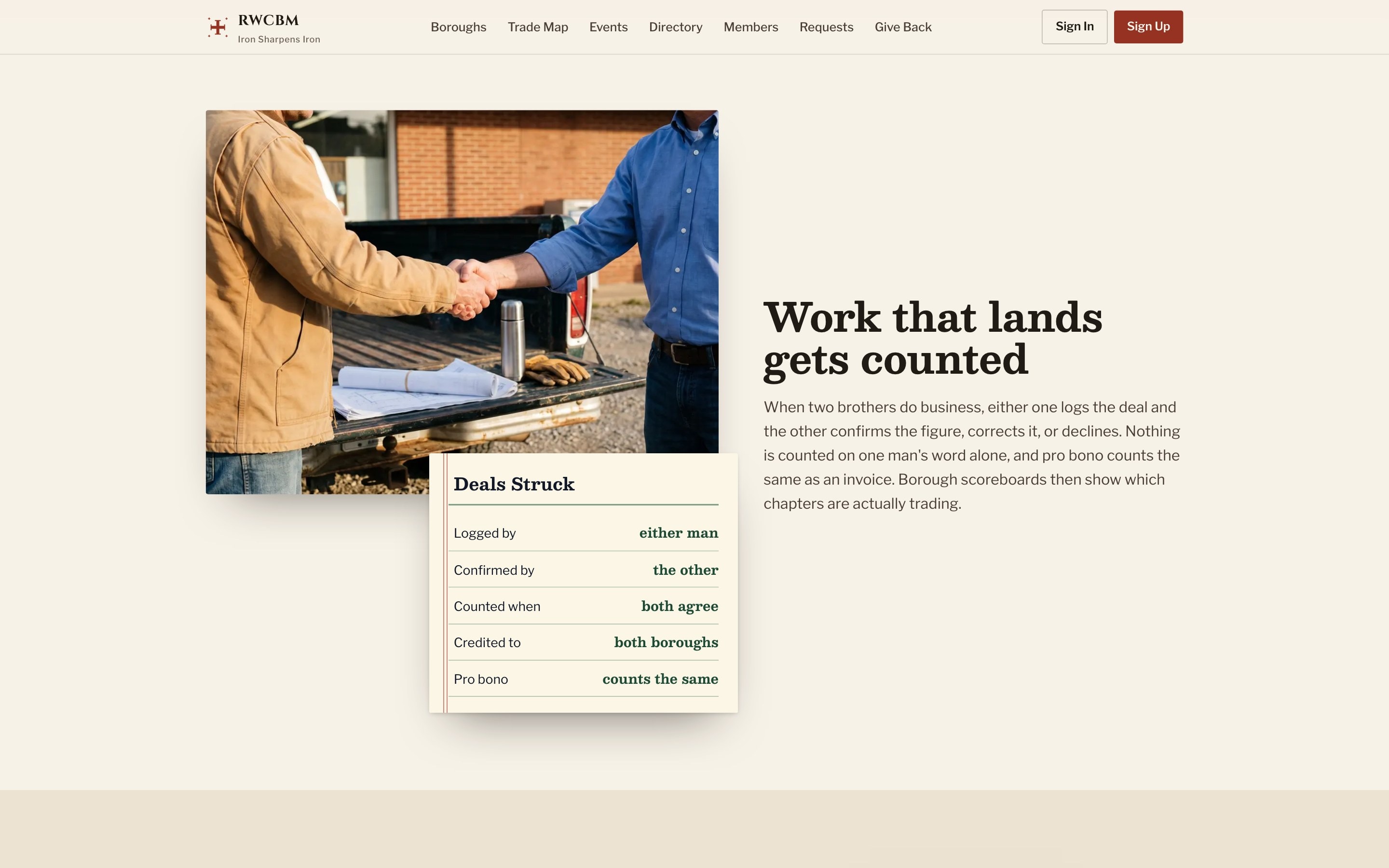
- Deals struck: either man logs the deal, the other confirms, corrects or declines it, and a confirmed deal is credited to both men's boroughs and their scoreboards.
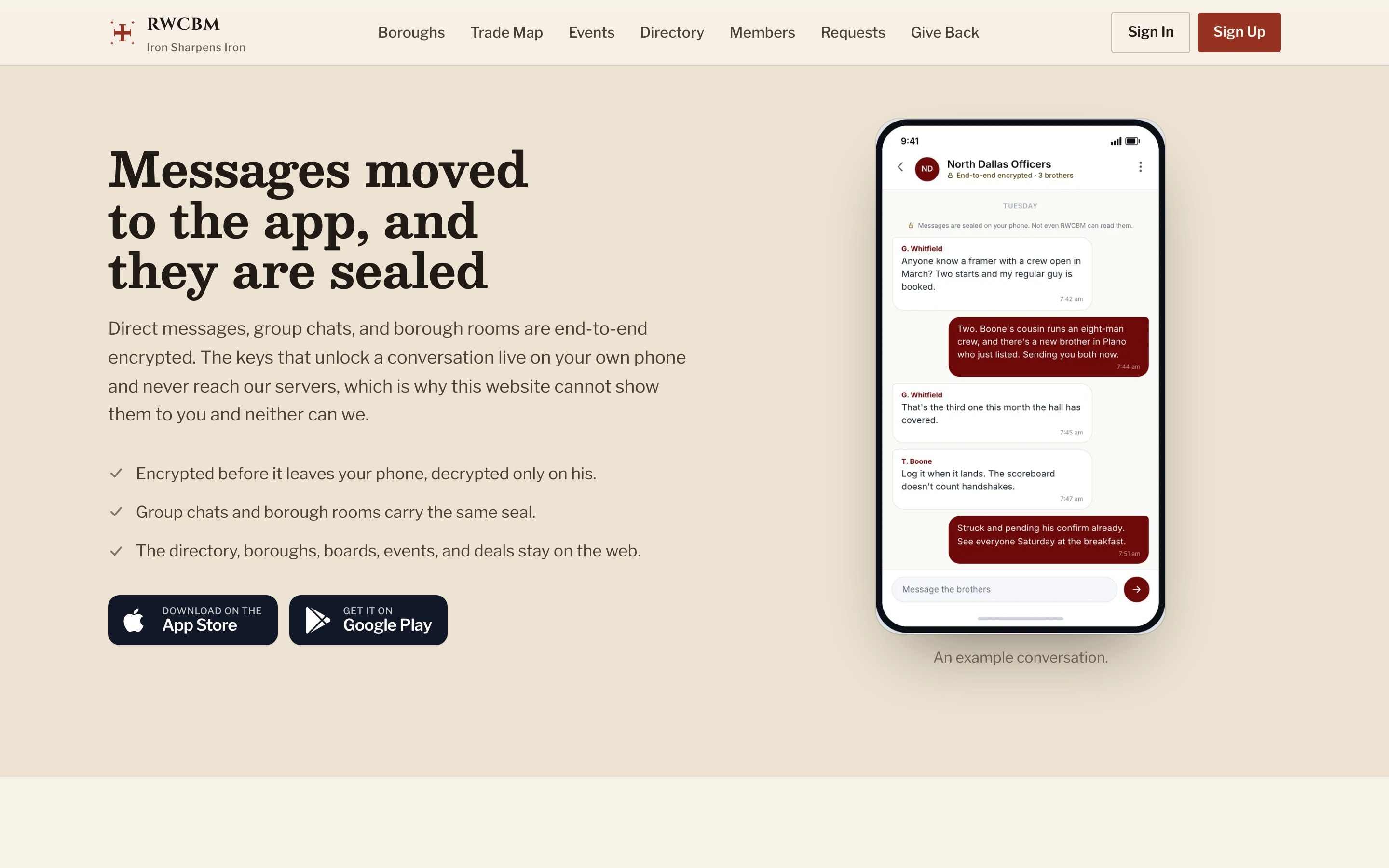
- Messaging lives in the app, end-to-end encrypted with Signal's own library, photos and group rooms included. The server keeps public keys and passes ciphertext, and the website cannot read a message.
- Search across eight parts of the hall, each copying the visibility rule of the page it searches, with a test that plants secret rows and fails if one shows up.
Inside the product
Captured from the live public site, signed out. Every screen shown on it is a replica filled with invented members, because everything past sign-in is member data.
Next project
RWCBM Mobile
The hall on the phone, with the messages sealed
Tell us about the business.
What it does, where, and what the website has to make happen. Within a day you will have a straight answer on what it takes to build, what it costs to run, and what we would cut. If the honest answer is that you do not need a new site, that is the answer you get.
Or skip the form entirely. hello@pinelandtech.com reaches a person, not a queue.